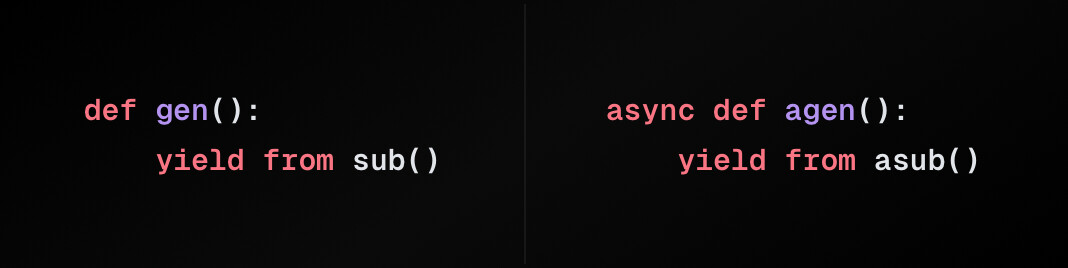
PEP 828: Supporting 'yield from' in asynchronous generators

Hi friends! Just wanted to say that the Steering Council has appointed @yselivanov as PEP delegate for PEP 828 and he has accepted. Given that Yury authored the original async/await and async generator PEPs, he’s well-positioned to make the call here. He will make a recommendation to the SC as soon as he finish deliberating.

Thanks you all for your patience!

21 Likes

If return values aren’t added then pluggy will be stuck using clutches for async

3 Likes

I think it’s a little more complicated than that, because to ensure timely cleanup you generally need to write with closing(gen()) as g: yield from g (or async variant). Unfortunately the [async] yield from expression in particular makes it very attractive to write the more concise but often-incorrect inline version instead.

As usual, I want to ensure that Trio users and flake8-async can ensure that every async function transitively yields-or-awaits back into the framework, so that timeouts can fire etc. Either the current proposal of distinguished async yield from and yield from expressions, or banning yield from <sync gen>-in-async-gen (lightly preferred, as I also have not seen uses for this), would work for me; but a yield from accepting either sync or async generators would not.

3 Likes

I’ve tried the reference implementation but I’m not sure the exception handling (athrow) is working right. Or maybe it is working but that indicates a mismatch between sync and async generators. Or maybe I’m missing something?

This version (all async) works:

async-test
"""async-test"""

import asyncio

async def get_nums():
    try:
        yield 1
    except EOFError:
        print("Don't care about EOF")
    yield 2
    yield 3
    print("get_nums finished")

async def my_gen():
    async yield from get_nums()
    print("my_gen done")

async def amain():
    g = my_gen()

    print(await anext(g))
    print(await g.athrow(EOFError()))
    print(await anext(g))
    try:
        print(await anext(g))
    except StopAsyncIteration:
        print("fin")

asyncio.run(amain())

This version (mixed sync async) doesn’t work:

sync-test
"""sync-test"""

import asyncio

def get_nums():
    try:
        yield 1
    except EOFError:
        print("Don't care about EOF")
    yield 2
    yield 3
    print("get_nums finished")

async def my_gen():
    yield from get_nums()
    print("my_gen done")

async def amain():
    g = my_gen()

    print(await anext(g))
    print(await g.athrow(EOFError())) # RuntimeError: Task got bad yield: 2
    print(await anext(g))
    try:
        print(await anext(g))
    except StopAsyncIteration:
        print("fin")

asyncio.run(amain())

I agree with


I’m a big fan of PEP 380 (yield from) in synchronous contexts. I’m glad it pushed back against the criticisms of allowing return values. I discovered yield from in the process of writing an incremental parser a couple of years ago. I was revisiting it a couple of days ago, and long story short I ended up discovering this PEP.

A very stripped down (and for a different task) version of the parser is below.

incremental-sync-parser
from typing import Generator, TypeAlias, TypeVar

T = TypeVar("T")

Returner: TypeAlias = Generator[None, None, T]

class IncrementalChunker:
    def __init__(self) -> None:
        self._results:   list[int]     = list()
        self._buffer:    bytes         = bytes()
        self._generator: Returner[int] = self._parse_forever()

        self._wakeup()

    def __iter__(self) -> Generator[int]:
        while self._results:
            yield self._results.pop(0)

    def feed(self, more_bytes: bytes) -> None:
        self._buffer += more_bytes
        self._wakeup()

    def _wakeup(self) -> None:
        self._generator.send(None)

    def _await_n_bytes(self, n: int) -> Returner[bytes]:
        while len(self._buffer) < n:
            yield

        ret          = self._buffer[:n]
        self._buffer = self._buffer[n:]

        return ret

    def _parse_forever(self) -> Returner[None]:
        while True:
            parsed = yield from self._parse_single()
            self._results.append(parsed)

    def _parse_single(self) -> Returner[bytes]:
        b_1 = yield from self._await_n_bytes(1)
        b_2 = yield from self._await_n_bytes(1)
        # could've used `_await_n_bytes(2)` but I'm
        # demonstrating a point of how we can wait

        return b_1 + b_2

decoder = IncrementalChunker()

decoder.feed(b"Hello")
for t in decoder:
    print("Round 1", t)
# Round 1 b'He'
# Round 1 b'll'

decoder.feed(b"")
for t in decoder:
    print("Round 2", t)

decoder.feed(b" ")
for t in decoder:
    print("Round 3", t)
# Round 3 b'o '

decoder.feed(b" World!")
for t in decoder:
    print("Round 4", t)
# Round 4 b' W'
# Round 4 b'or'
# Round 4 b'ld'

I’ll post later ( :sleeping_face: sorry I’m really busy with a project rn ) about trying to mimic asyncio (at-least the basics of PEP-3156 based on PEP 380 but pre PEP-492) using yield from, and trying to implement async generators as a subsequence of the yields. Just to see if it’s possible to spell out the yield from and/or async yield from formal semantics similar to PEP 380 in py code if possible, rather than browsing any intense reference implementation in C, and comparing yield from (sync) vs await (async).
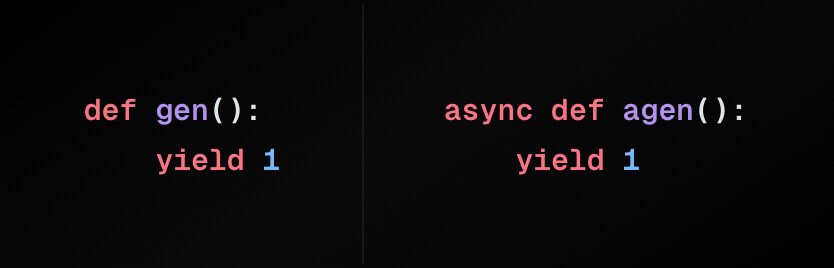
It looks like this case isn’t covered by our test suite, so I must have missed it. The bug is likely just a missing _PyAsyncGenValueWrapperNew call somewhere.

I have a branch where I started this, but I haven’t got around to finishing it yet. I think it’s less important for this PEP because the semantics are supposed to be exactly the same as PEP 380, so any differences should be immediately flagged as bugs.

1 Like

For the async iteration case, it’s important to spell out exactly where the yields are versus the awaits, and that’s not something PEP 380 covers.

Synchronous iteration is literally identical, so that can refer back to the existing behaviour (and highlight that as part of the rationale for requiring different syntax to request async iteration).

2 Likes

Just an update: I discussed this heavily at PyCon US and there’s a few changes that need to be made here.

In particular, Yury was able to convince me that delegation to synchronous subgenerators was a bad idea, because there’s a weird translation layer that doesn’t work well in practice. For example:

async def agen():
    async with asyncio.timeout(1):
        yield from syncgen()  # asyncio.TimeoutError can be injected into a *synchronous* generator!

That leaves the question of what syntax should be used for delegating to an async generator: should it be yield from or async yield from? I’m currently torn on this point.

Here’s a summary of the arguments:

  1. Overloading yield from to mean delegation to async from async would mean that we couldn’t ever add synchronous delegation in the future, though some argue that it will never happen anyway.
  2. Using yield from would break the convention that asynchronous context switches are explicitly prefixed with async.
  3. However, async yield from is verbose. As Pablo puts it, this would be the first “triple keyword trifecta” in Python.
  4. async yield from would break symmetry with yield in async generators, though yield doesn’t implicitly invoke any awaits.

I’m currently leaning towards async yield from, but I have also accepted that I will be unhappy with either decision.

1 Like

IMO the first two points are strong reasons to use async yield from, despite the verbosity. It’s wordy, but it’s built logically.

My brain is happy with this symmetry and would like it to be preserved; a theoretical async yield X would mean that yielding that thing could wait (which it can’t, but it’s at least logically sane).

TBH I think this is the strongest argument:

This is the biggest benefit of async/await over threads: you can see syntactically where every context switch can happen. It should be possible to quickly search for them all by eyeball or grep. The special case of a three-part word isn’t special enough to break the rule “if there’s a context switch, it has async”.

8 Likes

I’m not sure I find the “sync iterators aren’t expecting async timeout and cancellation exceptions” argument compelling (since resource cleanup doesn’t care about exception details), but if we do go with async-only delegation, perhaps it might make sense to spell it await from?

It’s not as explicit as async yield from, but I think the brevity is a genuine improvement.

That spelling also emphasises the connection between the new delegation expression and the return values of async generators.

Edit: on further reflection, I think that spelling works even if synchronous delegation is added later.

  • calls & yield: no external control flow delegation
  • await: delegates await
  • yield from: delegates yield
  • await from: delegates both await & yield

I’ll have to mull this one over. When discussing this in person, async from and some variations of it were also suggested and weren’t received too well.

The main issue is that it seems pretty important to have yield somewhere in the syntax, and it’s hard to spell that out without being verbose. We might just have to live with the verbosity, or go with plain yield from.

1 Like

The thought was mostly born from looking at async yield from and thinking “of those keywords, which feels the most redundant”, and concluding it was the yield.

The from implies the iteration, the async indicates that we expect a coroutine rather than a synchronous iterable. The yield does emphasise that the iteration body yields values, but that is already weakly implied by the from.

The step from async from to await from was then a matter of mentally reframing the delegation structure as “an await that can also yield additional values during its processing” rather than “an async for loop that can also return a value”.

It’s definitely not a perfect resolution, and I’d personally be equally fine with async yield from, but as a more concise spelling I’d vastly prefer it over making the meaning of a plain yield from context dependent.

2 Likes

Te feature needs to be possible*, not necessarily convenient.

I sprefer the explanation that “async yield from” is to “ yield from” as “async yield” is to “yield”, and shortening breaks that rhyme.

11 Likes

I agree with Guido on this. In the days of autocomplete and snippets (‘ayf’ expanding to ‘async yield from’), I wouldn’t worry too much about shortening. Clarity and understanding are more important to usage and teaching.

Thanks @ZeroIntensity for thoughtfully moving this forward.

6 Likes