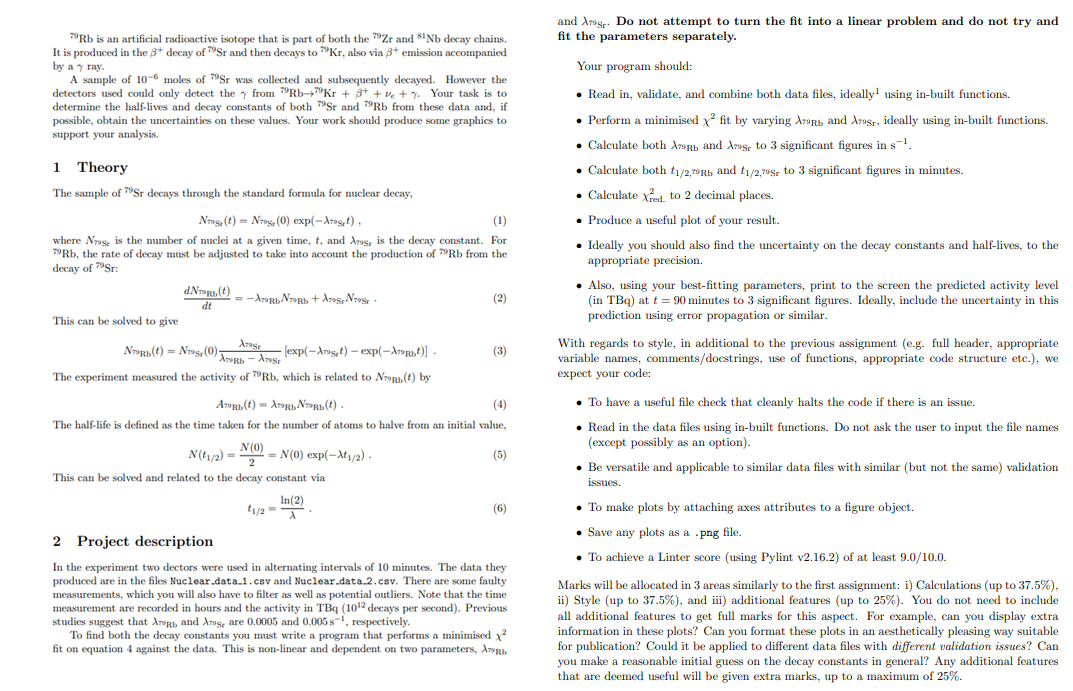
You should do your homework yourself. That means spending time struggling and working through to understand it. Feel free to come back if you have a specific question about Python.
This seems like something that pandas and scipy would be good for. Look in to those libraries and jupyter notebooks. Other than that you’re in your own 
The phrase “make plots by attaching axes to a figure object” sounds like a strong hint towards matplotlib, although presumably that’s what they’ve been teaching you.
Do you understand the physics? No great depth is required I think, once you understand that Rubidium is produced in a process you don’t see, but know the form of over time. Then it is consumed at a rate that has been observed for you. Sketch yourself a graph of what you expect to see (pencil and paper). What determines the shape of your sketch? They’ve given you the formula and approximate values for the two constants that matter.
Now the problem is to clean and merge the data, and fit it to the formula to get your own values for the constants, two of which you want.
aye, which means it might be a bad idea to use the marimo + polars (+ altair) tech stack.
Which is a shame, because the marimo interactive plot builder is amazing  . (I discovered this just recently)
This is a poor response. I’m obviously posting for guidance, not for someone to copy and paste the answer.
And yet you just copy and paste - even worse, screenshot - the question. Have you attempted to do your own homework? If so, what did you achieve? If not, why should we do it for you?
The screenshot is useful context for you to tell us what you’re struggling with. I enjoyed thinking about it.
Hayden has given you pointers to useful libraries and I have outlined a bit of physics I can remember. But neither of us knows whether that’s the help you need.
You could reply to one or other of us with “yes, I know all that because: 1. I have been studying nuclear physics for 3 years, or 2. I am an experienced data scientist”, and then tell us what you think so far about it, and where you got stuck.