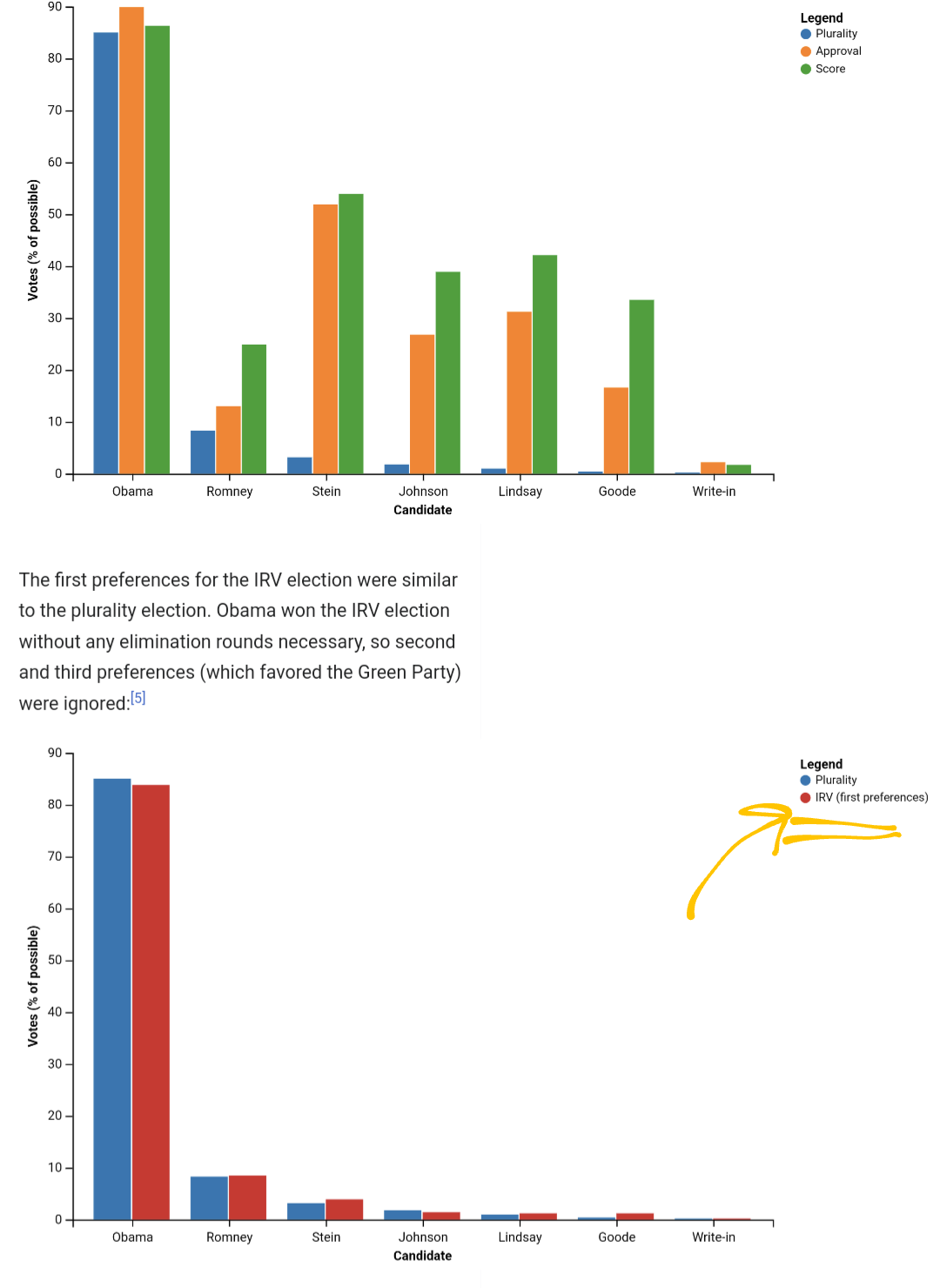
expressiveness can only be meaningfully measured in the result, not the ballot.
https://medium.com/election-science/expressiveness-6ef8c034bc65
STAR/score voting results are only marginally more expressive than approval voting.
expressiveness can only be meaningfully measured in the result, not the ballot.
https://medium.com/election-science/expressiveness-6ef8c034bc65
STAR/score voting results are only marginally more expressive than approval voting.
After the voting for the current Python Steering Council election is over, what information about the details of the voting will be made publicly available? In particular, will it include units such as contents of anonymous or anonymized individual ballots (AIBs)? To clarify, an AIB would be the numbers or lack thereof assigned to each candidate within an individual ballot as a bundle, but without any information that can be used to connect that ballot to a particular voter.
Looking ahead, is it anticipated that in future municipal elections with STAR voting, such information would be made available when the results are released? Having voters anticipate the release of such details would have some interesting upsides and downsides, but we can consider those later.
I ran some toy test elections last year, and left the last such available for viewing
At the bottom, there’s a “Download” button. You can click on that to download anonymized ballots, in your choice of CSV or JSON format.
Or you can click “Ballots” on the left side to view them in your browser.
How each ballot scored each candidate is shown. And a “ballot ID” is given for each ballot. That’s a string of “gibberish” that’s generated and given to you in the email receipt you get after voting. Nothing about your identity can be inferred from the gibberish, and not even our election admin can learn anyone’s ballot ID. It’s disclosed only to you in computer-generated email sent only to you..
And it’s an important feature for those who care: after the election ends, you can look at all the ballots reported, and verity for yourself that your ballot ID is among the ones reported, and faithfully records how you actually voted.
The ballot download is enough for us to independently verify every step the voting service claimed was the case during scoring.
Note that the service does not disclose anything about the names of voters, or their email addresses. Just ballot IDs.
A subtlety: you’ll notice that on some ballots, the score given to some candidates shows as a blank. That means the voter didn’t bother to explicitly assign a star rating to the candidate. That’s fine! It’s scored the same way as if they had assigned 0 stars. The distinction is preserved internally for research purposes.
No idea, but I hope so. Making the ballots available when an election ends isn’t a BetterVoting policy, it’s a choice made by an election admin when they use BetterVoting’s admin UI to set up an election to begin with.
We’re making them available because that was my recommendation after I considered the tradeoffs, and nobody else said anything about it. If people want to argue about it now, that’s fine. It’s one of the very few choices our election admin can change after an election starts.
Note that anonymized ballots were available from the different service used for the last PSF Board election, and I had great fun analyzing them from a dozen different directions  . The most surprising finding was that using a Proportional Representation variant of Approval (actually, seemingly any PR variant) would have changed one of the winners, but just barely so.
I intend to start down that line for this election too, but not to such obsessive extent. Picking 5 winners out of 6 candidates is close to a degenerate case, and I don’t anticipate any cause for controversy.
Lest anyone think this is crazy old Uncle Timmy just stirring up trouble again  , try reading the instructions BetterVoting put on your ballot in the election currently open:
Passing out a 0 and a 5 is how STAR is intended to work.
Going on to give 6 candidates 6 different ratings is my own twist, because I in fact do have “a preference” between each pair. For some pairs a strong preference, and for others very weak, but “a preference” nonetheless.
But if everyone did that (they won’t), it could get uncomfortably close to “Borda count” voting, which is probably the single “serious”’ voting method most open to strategic manipulation. Which Jean-Charles de Borda was aware of, but dismissed via saying “my scheme is only intended for honest men.” He wouldn’t last long in the 21st centruy
Making anonymized ballots available after the current Python Steering Council election is complete is indeed the best way to go. It will offer valuable opportunities for discussions about how well the system functioned as well as opportunities to perform various other informative analyses. I don’t think significant downsides apply to that with regard to this election.