How to vote under STAR

“Honesty is the best policy” under STAR. Trying to be clever has an excellent chance of backfiring. Because total scores don’t actually elect the winners - preference counts do. Scores only qualify candidates to enter runoff rounds. If you don’t express a preference between A and B (via giving them different scores), your ballot has no effect on which gets elected if A and B face off in a runoff. You can effectively disenfranchise yourself.

So various ways of insincerely exaggerating scores that do pay off under pure Range Voting (winners picked solely by total stars) are kneecapped by STAR’s runoff phase.

The STAR people have a good, more technical discussion, here:

Effective ways to try to game STAR generally require impossible foreknowledge of how others will vote.

What you should do:

  • Give your favorite 5 stars.
  • Give your least favorite 0 stars (or leave blank - scored the same way as 0).
  • Give others a number of stars relative to those, according to your beliefs.

Note that this is a single election. 5 shouldn’t be reserved for the best possible candidate in any conceivable election, nor 0 for the worst possible. “Best” and “worst” are relative to the single concrete election you’re voting in.

We’re still going to see “bullet ballots”, though: a ballot that gives 5 stars to one candidate, and none to anyone else. Which is an honest ballot if you truly believe only one candidate is even minimally acceptable.

What if you’re sure your favorite can’t win? Give them 5 stars anyway! There’s no such thing as a “wasted ballot” under this system. The preferences you express will still be counted with full force in the runoff round(s), acting to increase the chances that your more-preferred candidate(s) will win. Your ballot counts as much as everyone else’s in a runoff, even if none of the candidates you really like make it to a runoff.

Your 5 for a long shot doesn’t hurt anyone else. And your 5 will show up in the long shot’s final reported score, leaving visible evidence of their true support.

Honesty is the best policy under STAR. It’s aimed at electing consensus winners, and to do that best it needs to know voters’ honest preferences.

21 Likes

Great write-up, Tim – this kind of advice is definitely important! I have one question:

I don’t understand what you’re trying to say here. Is there an example that can clarify this?

2 Likes

It’s addressing something that surprised people running early real-life Range Voting elections: some number of ballots never give the highest possible score, or the worst. Seems to be because some people are thinking outside the context of the current election, rating candidates according to some abstract notion of the best (worst0 possible candidate in any possible election.

So there’s been energetic debate in the range voting world over whether ratings “should be” normalized before scoring: take a ballot’s actual scores and scale them proportionately to span

[minimum_posssible,_score, maximum_possible_score]

instead. Which nobody really wants to do. The STAR folks wisely (IMO) stayed out of this rabbit hole.

For example, maybe someone thinks you’re the best possible candidate in any possible Steering Council election, and won’t give anyone 5 stars other than you, ever, regardless of whether you’re running.

Nothing can stop them from doing that, but it’s not how it’s intended to work, and after some reflection I’m sure people can see on their own why it’s ill-advised.

3 Likes

Okay, so you’re saying that (in an election with only two candidates) people who dislike both candidates might give e.g. candidate A one star and candidate B two, whereas you say they should probably give zero and five stars. Makes sense.

4 Likes

Bingo. And in this respect it’s not like, say, rating products on Amazon, or giving stars to restaurants. Or, it is, depending on how you squint :wink:.

“The universe” matters. In an election, “the universe” is the candidates running in that election, and if you have any preferences at all then 5 should be given to the most favored and 0 to the least favored. And it doesn’t matter to that whether you’re mostly unimpressed by all the candidates, or think they’re all pretty great. You’re only expressing your preferences, not trying to sway anyone else, and to be as clear as possible about what your preferences are need to span the whole possible range of stars.

Although it’s not a tragedy if you don’t. For example, in the upcoming election I don’t think anyone merits a 0 on any “objective” measure - but I’ll be passing out at least one 0 anyway (and at least one 5), because I do have preferences.

In your example, I can see an argument for leaving A=1 and B=2. You have expressed a preference then, and in the runoff round the magnitude of the stars you assigned are ignored. It only matters which is larger, not by how much.

So there’s a stronger case to be made if there were more candidates than just A and B. Then leaving those rated both low hurts their chances of making it into a runoff round at all.

The human desire to game a system is, I’m afraid, irresistible :wink:

1 Like

As a sanity check, I asked a chatbot (this time Google’s Gemini) to summarize current thinking. I’m once again impressed by the quality of answers the current generation of these things can produce. Meaning that Gemini agreed with what I said :rofl:.

I’ll say that is a kind of “strategic voting”, because despite that I understand why, it still feels insincere to, say, give 0 stars to someone I actually don’t think is incompetent.

And this doesn’t really apply to a 2-candicate election: in that case they’ll both be in the one & only runoff round, and any difference in scores suffices to indicate your preference with full force.

Ideally, I’d like best a system that allowed to express things like “while I do have preferences, I think all the candidates are poor - or really good - or mediocre”. And under STAR, you can just pass out 0 and 1 - or only 4 and 5 - or only 2 and 3. But then, as the chatbot and I said, you lose the ability to express your preferences among them.

A fundamental problem is that the system isn’t asking about just your preferences, but about everyone’s. And a whole bunch of people will normalize their scores to span the full range possible even without reading my advice. To compete with them on a level playing field, you have to do the same :frowning:.

no, it’s actually an incredibly tiny marginal improvement. check out the (most realistic) brown dots representing 50/50 honestly vs strategy.
https://electionscience.github.io/vse-sim/vse-graph.html

1 Like

Sorry, I don’t see the relevance. VSE is about voter satisfaction with outcomes. I’m talking about quality of feedback, and mostly for those who didn’t win. VSE doesn’t try to measure that.

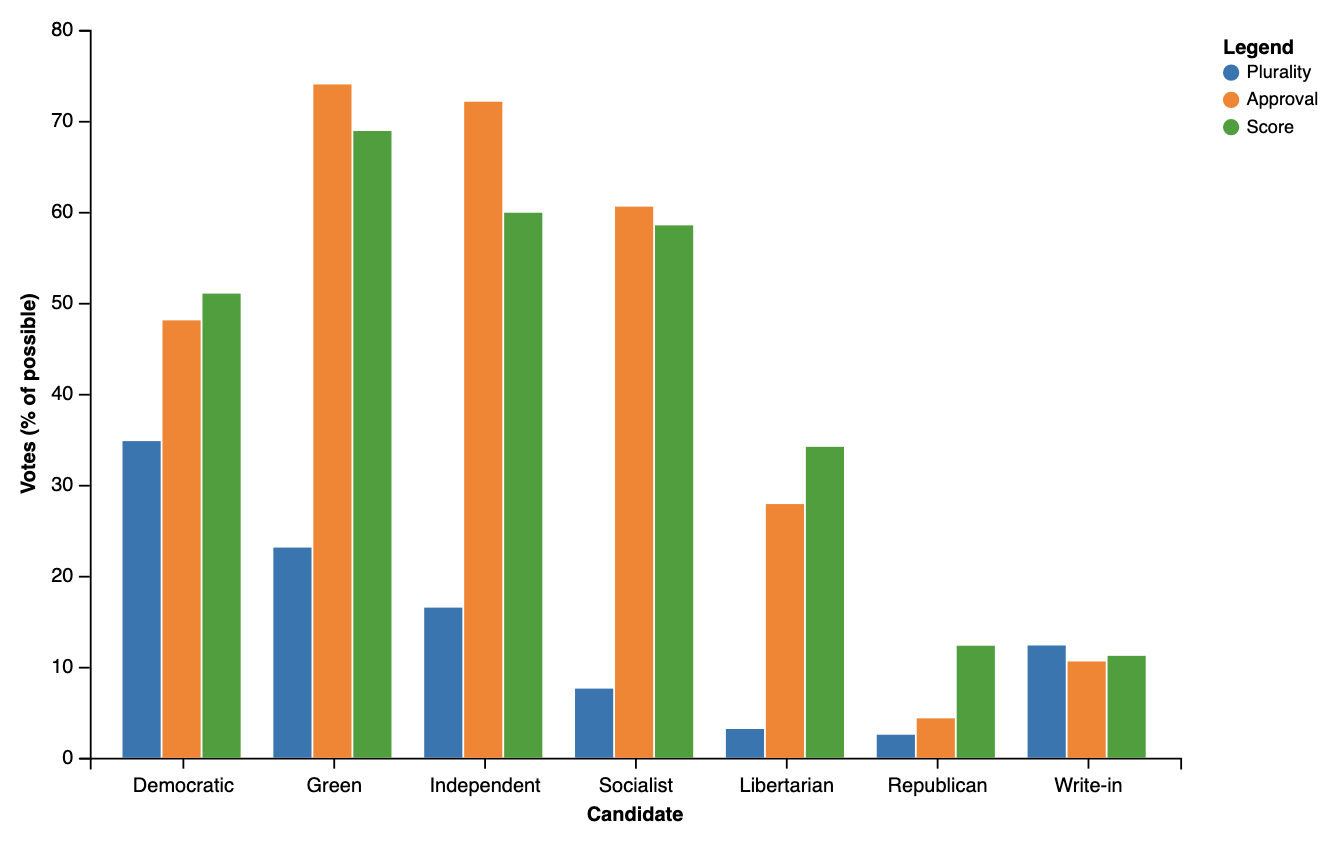
Under STAR, if there are at least 6 candidates, I’m likely to give a number of stars from all of 0 through 5 stars inclusive, so that my ballot has maximum effect in the runoff round(s) Approval simply doesn’t allow expressing such gradations to begin with. Different people will set their “approval cutoff” at different levels, but all information about how they did so is invisible.

I’m talking about quality of feedback, and mostly for those who didn’t win.

then approval voting is almost as good as score voting (the runoff STAR adds to score voting is irrelevant for this), since approval is just rounding up and down which mostly cancels out. see data from occupy wall street exit poll experiment for example.

yes, score voting is better, and i think the ideal, but not by a lot.

Here I disagree. The runoff is supremely relevant: It’s why I’ll pass out as many different star ratings as possible in an election, precisely so that my ballot “counts” in as many runoffs as possible. Under plain score voting instead, I’m as likely as anyone to pass out only max and min scores - that’s a well-known way to try to manipulate pure score systems via insincere gamesmanship, People who do that are effectively doing Approval voting in an indirect way (restricting themselves to only two scores).

The only thing I’d find convincing is head-to-head Approval vs STAR real-world results. Before then, it’s certainly the case that STAR allows me to express much more nuance than Approval, and the existence of runoffs removes incentives for me to strategically “hide” those nuances. To the contrary, runoffs incentivize me to express as much nuance as possible. Pure score doesn’t.

Here I disagree. The runoff is supremely relevant: It’s why I’ll pass out as many different star ratings as possible in an election, precisely so that my ballot “counts” in as many runoffs as possible. Under plain score voting instead, I’m as likely as anyone to pass out only max and min scores - that’s a well-known way to try to manipulate pure score systems via insincere gamesmanship,

there’s no evidence that the strategy is any different with star voting.

and more importantly, it doesn’t make much impact on the outcome. score voting with a mixture of strategic and honest voters or even completely strategic voters still performs about as well as star voting even if we naively assume everyone will be honest like you’re suggesting.

for what it’s worth, I’m basically the first person Mark informed when he invented star voting. after I spoke in favor of score voting at the Voting reform convention he convened. I was mentioned in the 2008 book gaming the vote which is an exploration of the game theory of tactical voting. I have co-authored several of the pages on strategic voting on ScoreVoting.net. You’re describing your gut intuition as if there is some scientific basis to it.

here’s an analysis by Warren Smith, the Princeton math PhD, who brought score voting into prominence in the electoral reform movement.

1 Like

What evidence are you going on? I’m not aware of any substantial body of publicly available actual real-life STAR elections to be analyzed. Appeal to authority is fine so far as it goes, but I wasn’t hatched yesterday either :wink:.

I’m running out of ways to repeat that I’m not talking about outcomes. I’m talking about quality of feedback. Any system that allows expressing more nuance has the possibility of providing better feedback, yes? In which case, what evidence do you have that STAR does not?

Which I didn’t suggest. I said that min-only max-only “strategic” voting is common under pure range voting, and that I personally find STAR’s runoff twist a strong incentive not to play those tricks under STAR. I don’t know to what extent others will, because I in fact don’t have evidence one way or the other yet. If you do, you haven’t presented it.

We’ll be running a STAR election here, and I look forward to digging into the results to see what can be learned from it. That will be worth more, to me, than volumes of 'head theories".

BTW, Warren Smith, in the page you linked to, said much the same about strategic range voting:

In strategic range voting, voters exaggerate scores to MAX and MIN hoping to increase their vote’s impact. (This tends to effectively convert range – and also STAR – into approval voting.)

Appeal to authority followed by a strawman? :wink: My own assessment of my own thinking is just that, and, as above, I didn’t claim it would apply to everyone. That it does apply to me just goes some way to establishing plausiblity.

Dr. Smith is “a character” for sure, and I’ve been familiar with his terrific site for years. When he has actual evidence, he spells it out. But here he resorts to hand-waving, like

Specifically I simply cannot believe STAR is better than range+runoff and if any sim says it is, that sim was just wrong.

Alas, he can’t argue about it with Jameson Quinn (“the Harvard statistics PhD”, most famous for greatly advancing the state of election simulation art) because Dr. Quinn died.

Which leaves a puzzle for you: while Dr. Quinn’s VSE pages don’t specifically address “range+runoff” (which has a separate runoff phase decided by plain two-candidate plurality, not STAR’s integrated “instant” runoff phase counting preferences on the same ballots), he did find STAR to be superior to pure range voting. Which Dr. Smith doesn’t seem to believe 'should be" possible.

Which seems to me typical of “authorities” pushing pet “head theories”: in the absence of hard evidence, I don’t pick a side, and it will never be resolved. I’m happy to go where the evidence leads, and even if the PSF’s election results are unique to the PSF’s electorate, that’s enough for me.

But let’s drop this. The PSF will be running a STAR election very soon, and that’s overwhelmingly the thing of interest on this forum. Do you have something to say about that? Do you think, e.g., it’s a bad idea? The we should be using something else instead? Do you object to the advice I’ve been giving about it ("give your favorite 5 stars, your least favorite 0, and give stars to the others according to how you judge them relative to those “anchors”)?. BTW, this is a Bloc STAR election, with 5 winners. Not some flavor of proportional STAR.

1 Like

Moved posts talking about Star voting, which were off topic in Why were there only six steering council nominations? - #19 by willingc to here. Please review our participation guidelines about how to interact productively.

4 Likes

No objection from me! I agree this is a much better place for them. Thank you.

I asked ChatGPT-5 to explain STAR in a way that would resonate with “Python people” - and it sure surprised me! Here it is, too good to keep to myself:

Simplicity is clarity, but nuance is truth.
A ballot should reveal, not conceal.
Majority is power; preference is wisdom.
Runoffs are inevitable — better they be automatic.
Approval is a shadow; STAR is the light.
Data is feedback, feedback is growth.
The best system is the one that disappears.
Fairness is not a feature, it is the foundation.
When voters are heard, candidates listen.
The map of democracy is drawn in ballots.

5 Likes

Moved to Core Development instead of Committers so others participants from moved discussion can continue to post.

6 Likes

Thanks, David, for the move so that we can all participate.

Thanks, Tim and ChatGPT-5, for what we might call The Zen of STAR Voting, consisting of eleven Pythonic principles, but of course with only ten of them actually stated. :grin:

3 Likes

In fact, the bot named it the “Zen of STAR”. I was astonished. It’s a fine attempt, and I thanked it for the laughs - but also advised it not to quit its day job :wink:

3 Likes

@ClayShentrup, I’ve been puzzled by what seemed to me to be an overly combative tone in your messages here. I suspect it’s because you’re wearing your “Center for Election Science” advocacy hat and reflexively countering what you take to be criticism of Approval.

But that’s not what’s in play here. The PSF has happily used Approval since 2017 - we’re a “success story” for the method you’re most associated with (although I doubt many others here are aware of your connection, those of us who are extend our deep thanks to you for your tireless efforts on Approval’s behalf).

But you know better than most that Approval’s 'it’s more expressive!" selling point is very attractive to people, and that “RCV” advocates have employed “and we’re even more expressive!” to great effect. STAR advocates have tried that line too, but STAR actually delivers what RCV only claims to deliver (and I’ll let pass that Warren Smith seems to believe that STAR is just as friendly to eternal 2-party domination as plurality - I think he’s just wrong about that, but this is another point on which real-world evidence is conspicuous by absence - but there’s plenty of real-world evidence that RCV under various names is extremely effective at kneecapping third parties in areas already dominated by two, giving a mere illusion of “choice”).

The widespread desire for greater expressiveness is what drove the current move to STAR. People have been “happy enough” with Approval overall, but want the possibility to express more of what they believe. Hence my years-long but low-grade advocacy for STAR in the PSF. It’s that or RCV, and I know you too believe STAR is a far better choice.

When we were voting on whether to adopt STAR last year, I was very clear about (and so was @dstufft) that I didn’t expect it would change outcomes in Steering Council elections. While you keep stressing that outcomes are much the same regardless, that’s never been disputed by anyone here.

The point here is satisfying demand for greater expressiveness. That’s a matter of social dynamics. I happen to believe the greater expressiveness of STAR will lead to better feedback in the context of PSF elections, because I know for a fact that my own ballots will express more nuance, and expect (but don’t know) that most PSF voters specifically will also express more nuance. You apparently don’t believe that. Disagreement is fine, but there’s no “QED” in sight for either side from disputing that with mere words. The election results will give us actual data in a few weeks.

I look forward to that. In the meantime, please consider that, at heart, we’re on the same side here :smiley:

1 Like

To be very clear about this, there are 6 candidates in this year’s SC election. STAR offers 6 possibilities for each (from 0 through 5 stars inclusive), and I will use all 6..I’ll give one candidate 5 stars, another 4 stars, …, and another 0 stars. That way my ballot will count in every possible runoff round, because I have expressed “a preference” between every pair.

So I’m, in some sense, “gaming the system”. But I’d say in a benign way. I’m not trying to manipulate it, just taking full advantage of the opportunity to express as much of what I believe as is possible in this system, and by giving my honest opinions.

I recommend you do the same. But, of course, you’re free to do whatever you like. Just be aware of that, if you do give two candidates the same number of stars, if they face each other in a runoff your ballot will have no effect on which wins. Mine will :wink: