The primary reason for not including the newline immediately after the opening triple quote in the string is intuitive clarity. As can be seen from the sample code of textwrap.dedent(), where a backslash is written immediately after the opening triple quote to remove the newline, it is very unnatural and difficult to understand when lines within the string to be dedented start after the opening triple quote rather than with an indent.
Instead of thinking that d-strings remove indentation and line breaks from triple-quoted strings, consider that d-strings treat the part after the indentation as the body of the string.
The following image visually explains why the newline immediately after the opening triple quote is ignored, while the newline before the closing triple quote is naturally and clearly included in the string.
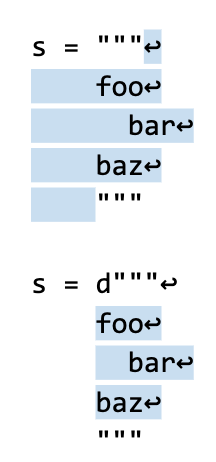
Another reason to ignore the newline immediately after the opening triple quote is to leave room for adding something there in the future.
It may allow writing comments starting with # in the future. Previous thread about d-string had proposed adding language hint there.
However, to move the discussion forward, we propose the specification of this PEP with room to add those ideas in the future.