I’m late to the game here, but I want to emphasize Ethan’s point. The original attraction of markup systems like reST and Markdown (maybe their raison d’être) was that the text with its light markup was readable as-is. As opposed to, say, LaTeX.
My recommendation is that instead of adopting a somewhat meaningless convention just to make diffs more readable on GitHub, that you separate content changes from formatting changes. If you need to add/delete/change some text, do it without reflowing the paragraph. After awhile, if the paragraph (or document as a whole) gets tough to read, then make an edit which is notion more than reformatting — no content changes. This is no different than the admonition to separate semantic and formatting changes in the C or Python source code.
It also helps to have tools which do a better job presenting you with the actual changes. I happen to (lo, these many years) still be an Emacs user. It’s ediff system presents changes cleanly, identifying both the formatting bits (light green or red text background) and the content bits (somewhat darker green or red background). Here’s a simple edit of the C API’s unicode.rst file which demonstrates both.
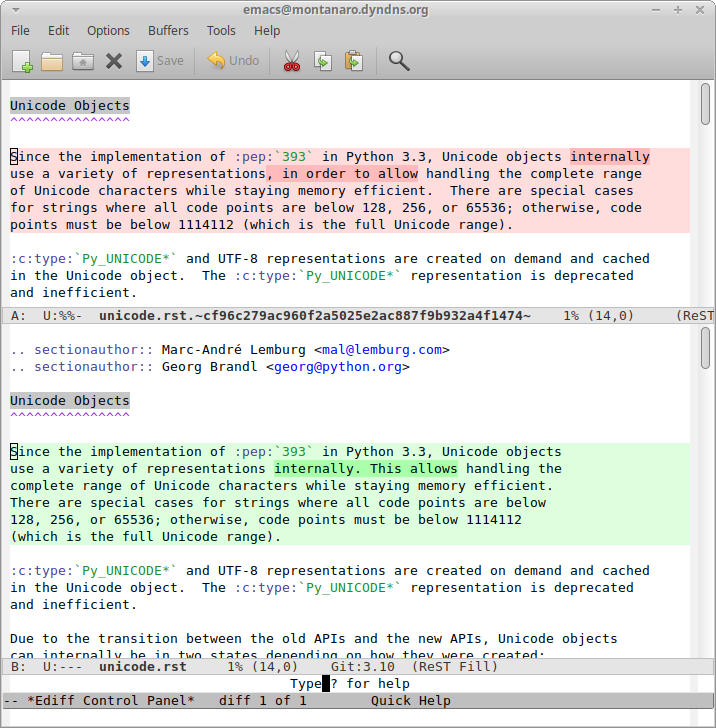
I don’t normally use GitHub to compare differences between two versions of a file. Does it not do something meaningful like this? What other tools do people use to edit text that make it difficult to distinguish between semantic and formatting changes?
In the end, I hope it becomes a “to each their own” sort of thing. I wouldn’t want to see any particular editing style mandated.