Whenever I tried to work through the tutorial, I wished I had it as a handy printed book. Learning with a physical book seems easier and more enjoyable for me. Maybe it’s the same for other people.
What do you think about the following idea?
Providing The Python Tutorial as a printed book in a handy size
Distributing it through a print-on-demand service. e. g. Amazon
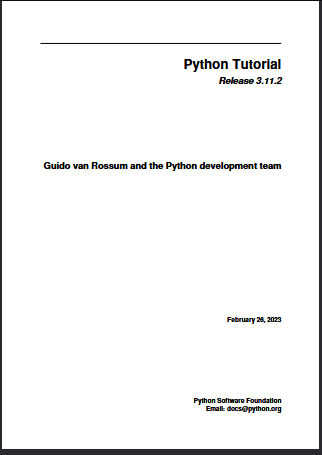
The tutorial is hugely underrated. There used to be downloadable .pdfs of the tutorial (see attached from 2023) and other parts of the docs, but apparently pdfs can still be built of more recent versions.
Is anything more needed to order DIY versions, than rendering a .pdf, and sending it to a print-on-demand service?
I would rather not be listed as the author. Most of the text isn’t mine, and IIRC being listed as an author on Amazon has some undesirable side effects.
I wonder if it would be trademark issue for printing out the tutorial and selling it on Amazon? Are you asking this as a business idea? Or do you just want to have a book printed for yourself?
Anyway, there are already many Python tutorial books out there that you can buy without much hassle.
Learning styles and preferences vary wildly (as an author you undoubtedly know this ). I wouldn’t ever want to go back to my university days when “the manual” for UNIX was several feet long in a frame bolted to a desk. On the other hand, I detest “gamified” learning schemes where it’s all a quest to gain points and little cutsie tokens, but they work for people or they wouldn’t be so popular.
Use of the word “Python” in the name of books or publications like “Python Journal” and “Python Cookbook” – Allowed if for the Python programming language.
I suppose this applies.
I’d rather wonder wether it is possible to use the work of others (those that made the docs) for commercial use, being a print that is sold. That basically means that those others help you make money, without any kind of reward being given in return. I do however note, that the same applies to any commercial product using Python as a language itself. Generally though, I think there is nothing that would be against this.
I’d rather wonder wether it is possible to use the work of others (those that made the docs) for commercial use, being a print that is sold. That basically means that those others help you make money, without any kind of reward being given in return. I do however note, that the same applies to any commercial product using Python as a language itself. Generally though, I think there is nothing that would be against this.
If you look back on the seminal “Running Linux” (1995) distributed by O’Reilly Press, the first leader of the Linux Documentation Project was credited as author even though it was partly a compilation of open license manpages and similar documentation for various GNU and related tools. It carries a very lengthy Acknowledgements section which begins, “This book is the result of many people’s efforts, and as expected, it would be impossible to list them all here.”
I’m just saying that it may be beneficial to ask all (not only core) devs for their opinion, e.g. as a poll. Obviously not everyone can and will participate, but it might be good to know the community’s general opinion.
So your next step is to open the PSF license v2 and read the 8 points. It should tell you if you can print the docs for yourself, if you can print it for others, if you can receive money for doing so. If you’re still unsure you could ask the PSF legal email, or a lawyer.
As for publishing on a service: you could check with a lawyer if the licensing and trademark rules let you do that, and with what name. Personally I would question the relevance of putting the tutorial on paper, as the web version is regularly changed and updated, and hypertext makes it easy to link to other parts of the docs, save bookmarks, find other resources… I don’t see much appetite for print.
Even I learn better with a physical book. It’s easier to focus, mark important points and read without any distraction and having the python tutorial in a small printed format would really help. Plus, print on demand service like amazon make it easy to share with others who prefer offline learning.
 ). I wouldn’t ever want to go back to my university days when “the manual” for UNIX was several feet long in a frame bolted to a desk. On the other hand, I detest “gamified” learning schemes where it’s all a quest to gain points and little cutsie tokens, but they work for people or they wouldn’t be so popular.